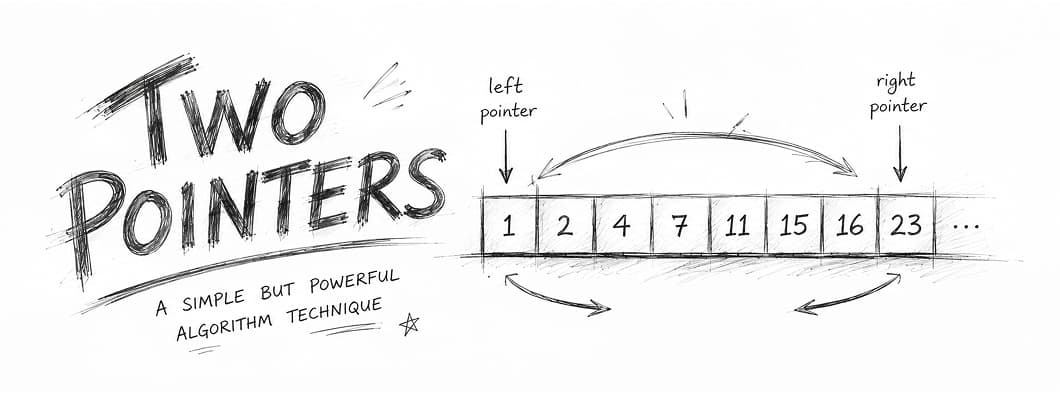
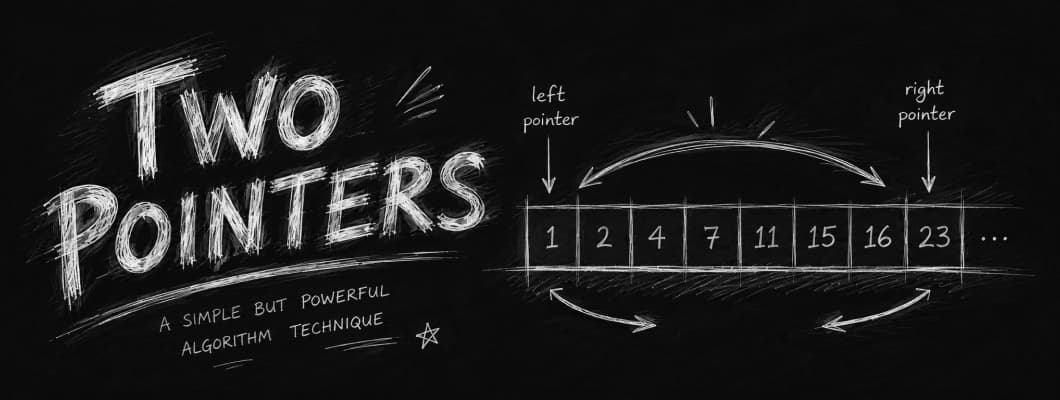
3Sum

Sort the array, fix one value as a moving target, and reuse the exact two-pointer proof from Two Sum II to sweep the rest — with a couple of extra duplicate-skipping rules layered on top.

12 min read
#algorithms
In one line

Fix one number at a time and hunt for a pair that cancels it out — which turns three unknowns into a Two Sum II problem run once per fixed value.

time O(n^2)space O(1)

Given an array, find every unique triplet that sums to zero. Checking every triple directly costs O(n3)O(n^3), and even before that, "every unique triplet" hides a second problem: the same values can be found more than once unless duplicates are handled deliberately.

Sorting first solves both problems at once. It makes the two-pointer sweep valid, and it puts equal values next to each other so they're cheap to skip.

Why fixing one value turns this into Two Sum II

Reduce to a problem you've already solved

  • Fixing nums[i] as the pivot turns "three numbers sum to zero" into "two numbers sum to -nums[i]" — exactly Two Sum II, just with a target that moves as the outer loop advances.
  • The sorted order that makes the inner two-pointer sweep valid is the same proof as before: the sum tells you which side is hopeless to keep.
  • Once nums[i] > 0, no pivot from here on can reach zero with two non-negative-or-larger partners — the outer loop can stop.

What sorting doesn't solve by itself

  • Skipping duplicate values inside the inner sweep only avoids repeating a pair for one fixed pivot — you still need to separately skip a pivot value that repeats the previous one.
  • It doesn't bound the output size: in the worst case (many zeros) the result itself has O(n2)O(n^2) triplets, so the total work can't beat that no matter how the pointers move.
  • Sorting discards the original indices — fine here, since the answer only needs values, not positions.
Signals in the problem statement
  • "triplets" or "three numbers" that sum to a target
  • "no duplicate triplets in the result"
  • asked for every valid combination, not just one
  • values (not original positions) matter in the answer

The pattern

  1. 1Sort the array.
  2. 2

    For each index i, skip it if it repeats the previous pivot.

  3. 3

    Two-pointer the remainder for target -nums[i], skipping repeat values on left and right after recording a hit.

  4. 4Stop the outer loop once nums[i] > 0.
@itsnas three-sum.ts
codethree-sum.ts
function threeSum(nums: number[]): number[][] {
  nums.sort((a, b) => a - b)
  const result: number[][] = []
 
  for (let i = 0; i < nums.length - 2; i++) {
    if (nums[i] > 0) break
    if (i > 0 && nums[i] === nums[i - 1]) continue // skip pivot dupes
 
    let left = i + 1
    let right = nums.length - 1
 
    while (left < right) {
      const sum = nums[i] + nums[left] + nums[right]
      if (sum === 0) {
        result.push([nums[i], nums[left], nums[right]])
        while (left < right && nums[left] === nums[left + 1]) left++
        while (left < right && nums[right] === nums[right - 1]) right--
        left++
        right--
      } else if (sum < 0) {
        left++
      } else {
        right--
      }
    }
  }
 
  return result
}
fn three_sum(mut nums: Vec<i32>) -> Vec<Vec<i32>> {
    nums.sort();
    let mut result = Vec::new();
 
    for i in 0..nums.len().saturating_sub(2) {
        if nums[i] > 0 {
            break;
        }
        if i > 0 && nums[i] == nums[i - 1] {
            continue;
        }
 
        let (mut left, mut right) = (i + 1, nums.len() - 1);
 
        while left < right {
            let sum = nums[i] + nums[left] + nums[right];
            if sum == 0 {
                result.push(vec![nums[i], nums[left], nums[right]]);
                while left < right && nums[left] == nums[left + 1] {
                    left += 1;
                }
                while left < right && nums[right] == nums[right - 1] {
                    right -= 1;
                }
                left += 1;
                right -= 1;
            } else if sum < 0 {
                left += 1;
            } else {
                right -= 1;
            }
        }
    }
 
    result
}
std::vector<std::vector<int>> threeSum(std::vector<int>& nums) {
  std::sort(nums.begin(), nums.end());
  std::vector<std::vector<int>> result;
 
  for (int i = 0; i < (int)nums.size() - 2; i++) {
    if (nums[i] > 0) break;
    if (i > 0 && nums[i] == nums[i - 1]) continue;
 
    int left = i + 1, right = nums.size() - 1;
 
    while (left < right) {
      int sum = nums[i] + nums[left] + nums[right];
      if (sum == 0) {
        result.push_back({nums[i], nums[left], nums[right]});
        while (left < right && nums[left] == nums[left + 1]) left++;
        while (left < right && nums[right] == nums[right - 1]) right--;
        left++;
        right--;
      } else if (sum < 0) left++;
      else right--;
    }
  }
 
  return result;
}
func threeSum(nums []int) [][]int {
	sort.Ints(nums)
	var result [][]int
 
	for i := 0; i < len(nums) - 2; i++ {
		if nums[i] > 0 {
			break
		}
		if i > 0 && nums[i] == nums[i-1] {
			continue // skip pivot dupes
		}
 
		left, right := i+1, len(nums) - 1
 
		for left < right {
			sum := nums[i] + nums[left] + nums[right]
			switch {
			case sum == 0:
				result = append(result, []int{nums[i], nums[left], nums[right]})
				for left < right && nums[left] == nums[left+1] {
					left++
				}
				for left < right && nums[right] == nums[right-1] {
					right--
				}
				left++
				right--
			case sum < 0:
				left++
			default:
				right--
			}
		}
	}
 
	return result
}
def three_sum(nums: list[int]) -> list[list[int]]:
    nums.sort()
    result = []
 
    for i in range(len(nums) - 2):
        if nums[i] > 0:
            break
        if i > 0 and nums[i] == nums[i - 1]:
            continue  # skip pivot dupes
 
        left, right = i + 1, len(nums) - 1
 
        while left < right:
            total = nums[i] + nums[left] + nums[right]
            if total == 0:
                result.append([nums[i], nums[left], nums[right]])
                while left < right and nums[left] == nums[left + 1]:
                    left += 1
                while left < right and nums[right] == nums[right - 1]:
                    right -= 1
                left += 1
                right -= 1
            elif total < 0:
                left += 1
            else:
                right -= 1
 
    return result
main
Naseebullah

Complexity

Time

An O(n) two-pointer sweep runs once per pivot, dominating the O(n log n) sort.

Space

Auxiliary space only — excludes the sort's internal use and the output list itself.

Common pitfalls

1

Forgetting to skip duplicate pivots

Not comparing nums[i] to nums[i - 1] reruns the identical inner sweep for equal pivot values, producing the same triplet more than once.

2

Forgetting to skip duplicates after a hit

Advancing left and right by one without first skipping past equal neighbours re-records the same triplet on the next iteration.

3

Starting the inner pointers at the wrong index

left and right must start at i + 1 and n - 1 — starting left at 0 lets the pivot pair with itself.

4

Moving the wrong inner pointer

Same inversion risk as Two Sum II, just against a moving target: move left when the sum is too small, right when it's too big.

Variants worth knowing

  1. 1

    3Sum Closest — track the closest sum seen instead of matching exactly.

  2. 2

    4Sum — fix two pivots instead of one, then two-pointer the rest; the same idea nested a level deeper.

  3. 3

    Valid Triangle Number — fixes the largest value instead of walking forward, and counts a whole range of pairs per step instead of one at a time.


Practice, easiest first


What's next in the notebook?

Keep reading — more from where that came from.

Valid Triangle Number

9 min read
#algorithms
Sort the side lengths, fix the largest one at a time, and let the gap between two pointers count every valid pair against it in one step instead of testing them one by one.

Two Sum II

8 min read
#algorithms
A sorted array, two pointers closing in from both ends, and a proof that whichever side is off-target can be ruled out entirely rather than retried against a smaller search space.

Container With Most Water

7 min read
#algorithms
A row of walls, two pointers starting at the widest container, and a proof that moving the taller wall can never beat what you already have — so only the shorter side is ever worth moving.

Two Pointers

7 min read
#algorithms
Two indices walking through one ordered structure, discarding the side that cannot improve the answer at every step and replacing a nested loop with a single pass.

Copyright © 2025-present itsnas.me 
All Rights Reserved.